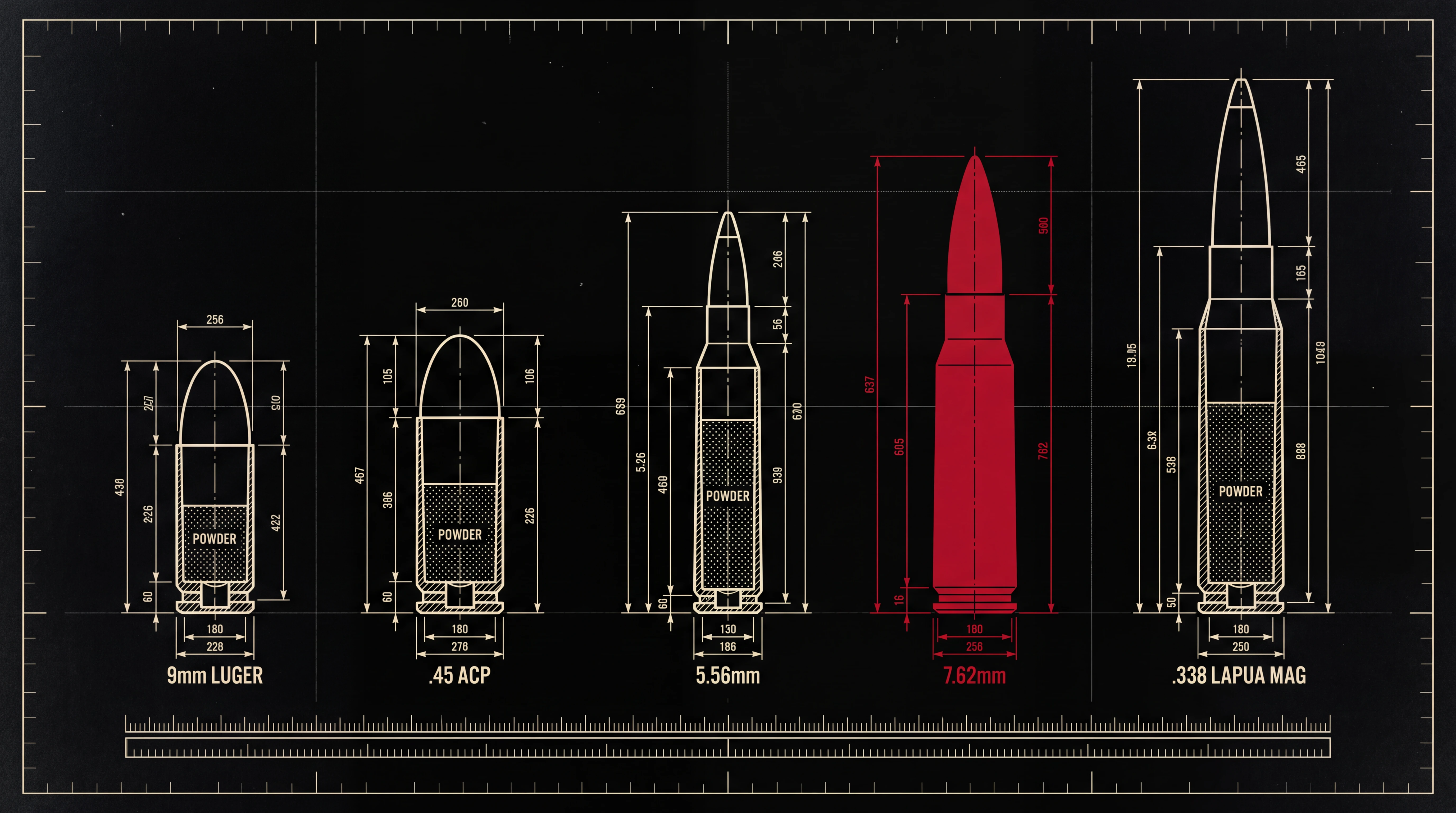
If you're building a firearms-related application, understanding caliber data is essential. Whether you're developing a game, a reference app, or an inventory management system, caliber specifications determine firearm compatibility, performance characteristics, and realistic behavior modeling. This guide covers everything developers need to know about firearm calibers and how to work with caliber data through the GunSpec API.
What Are Firearm Calibers?
A caliber is a specification that defines the ammunition a firearm uses. At its most basic, it refers to the internal diameter of a gun barrel and the corresponding diameter of the projectile (bullet) it fires. However, caliber designations also encode information about case length, powder charge, bullet weight, and sometimes even the designer or military specification.
For developers, calibers are essentially foreign keys that link firearms to their compatible ammunition types. A single firearm can support multiple calibers (like the Desert Eagle firing .357 Magnum, .44 Magnum, or .50 AE), and a single caliber can be used by hundreds of different firearm models.
Understanding Caliber Designations
Caliber naming conventions can be confusing because they mix measurement systems, historical naming, and marketing terminology. Here are the main patterns:
Metric Designations
European and Soviet-era calibers typically use metric measurements in the formatbullet_diameter × case_length. For example:
- 9×19mm Parabellum - 9mm bullet diameter, 19mm case length (also called 9mm Luger)
- 7.62×39mm - 7.62mm bullet, 39mm case (standard AK-47 round)
- 5.56×45mm NATO - 5.56mm bullet, 45mm case (standard AR-15/M16 round)
Imperial Designations
American calibers often use inches, sometimes with historical or proprietary suffixes:
- .45 ACP - .45 inch diameter, "Automatic Colt Pistol"
- .308 Winchester - .308 inch diameter, named after Winchester
- .50 BMG - .50 inch diameter, "Browning Machine Gun"
NATO and Military Designations
NATO standardized calibers have both metric and imperial equivalents. The 5.56×45mm NATO is nearly identical to the commercial .223 Remington, and 7.62×51mm NATO matches .308 Winchester. These are often (but not always) interchangeable.
Shotgun Gauges
Shotguns use a different system called "gauge," based on how many lead balls of the barrel's diameter equal one pound. 12 gauge is the most common, meaning 12 lead balls = 1 pound. The exception is .410 bore, which is actually a caliber measurement (.410 inches).
Key Caliber Data Points
When working with caliber data in your application, these are the essential fields you'll encounter:
- Name - The standard designation (e.g., "9×19mm Parabellum")
- Bullet Diameter - Actual projectile diameter in mm or inches
- Case Length - Cartridge case length (metric calibers)
- Case Type - Rimmed, rimless, belted, bottleneck, straight-wall
- Typical Bullet Weight - Measured in grains (1 grain = 64.79891 mg)
- Muzzle Velocity - Speed of the bullet leaving the barrel (fps or m/s)
- Muzzle Energy - Kinetic energy of the bullet (ft-lbs or joules)
- Effective Range - Practical accuracy distance
- Common Firearms - List of firearms that chamber this caliber
These specifications determine everything from damage models in games to inventory compatibility in tracking systems.
Querying Caliber Data with GunSpec
The GunSpec API provides comprehensive caliber data through the /v1/calibersendpoint. Here's how to query it:
// GET https://api.gunspec.io/v1/calibers// Headers: X-API-Key: your_api_key
{  "data": [    {      "id": 1,      "name": "9×19mm Parabellum",      "alternateNames": ["9mm Luger", "9mm NATO"],      "bulletDiameter": 9.01,      "bulletDiameterUnit": "mm",      "caseLength": 19.15,      "caseLengthUnit": "mm",      "caseType": "rimless, tapered",      "typicalBulletWeight": 124,      "bulletWeightUnit": "grains",      "muzzleVelocity": 1180,      "muzzleVelocityUnit": "fps",      "muzzleEnergy": 383,      "muzzleEnergyUnit": "ft-lbs",      "effectiveRange": 50,      "effectiveRangeUnit": "meters",      "description": "The 9×19mm Parabellum is one of the most widely used handgun cartridges in the world.",      "origin": "Germany",      "yearIntroduced": 1902,      "designer": "Georg Luger",      "commonFirearms": ["Glock 17", "Beretta M9", "SIG P320", "CZ 75"],      "militaryDesignation": "9mm NATO",      "createdAt": "2025-01-15T10:30:00Z",      "updatedAt": "2025-01-15T10:30:00Z"    },    {      "id": 2,      "name": "5.56×45mm NATO",      "alternateNames": [".223 Remington"],      "bulletDiameter": 5.56,      "bulletDiameterUnit": "mm",      "caseLength": 44.7,      "caseLengthUnit": "mm",      "caseType": "rimless, bottleneck",      "typicalBulletWeight": 62,      "bulletWeightUnit": "grains",      "muzzleVelocity": 3100,      "muzzleVelocityUnit": "fps",      "muzzleEnergy": 1325,      "muzzleEnergyUnit": "ft-lbs",      "effectiveRange": 500,      "effectiveRangeUnit": "meters",      "description": "Standard NATO rifle cartridge used by most Western military forces.",      "origin": "United States",      "yearIntroduced": 1980,      "designer": "Remington Arms / Eugene Stoner",      "commonFirearms": ["M16", "M4 Carbine", "AR-15", "HK416"],      "militaryDesignation": "5.56×45mm NATO",      "createdAt": "2025-01-15T10:30:00Z",      "updatedAt": "2025-01-15T10:30:00Z"    }  ],  "pagination": {    "page": 1,    "limit": 100,    "total": 47,    "totalPages": 1  }}
You can also query specific calibers by ID or search by name. Check the API documentation for all available filters and query parameters.
Common Calibers Every Developer Should Know
If you're building a firearms application, these calibers appear most frequently and represent the core specifications you should support:
Handgun Calibers
- 9×19mm Parabellum - The most popular handgun caliber worldwide. Used by police, military, and civilians. Low recoil, high capacity.
- .45 ACP - Classic American handgun round. Larger, slower, heavier bullet. Known for stopping power.
- .40 S&W - Compromise between 9mm and .45 ACP. Popular with law enforcement.
- .357 Magnum - Powerful revolver cartridge. Can also fire .38 Special.
- 10mm Auto - High-power semi-automatic round. Used for hunting and defense.
Rifle Calibers
- 5.56×45mm NATO / .223 Remington - Standard AR-15/M16 round. High velocity, low recoil.
- 7.62×39mm - AK-47 caliber. Intermediate power, very common globally.
- 7.62×51mm NATO / .308 Winchester - Full-power rifle cartridge. Battle rifles and hunting.
- .30-06 Springfield - Classic American hunting and military round.
- .50 BMG - Heavy machine gun and anti-materiel rifle caliber.
Shotgun Calibers
- 12 Gauge - Most common shotgun caliber. Versatile for hunting, sport, defense.
- 20 Gauge - Lighter recoil, popular for smaller shooters and upland game.
- .410 Bore - Smallest common shotgun caliber. Used for small game.
Linking Calibers to Firearms
In the GunSpec database, calibers and firearms are connected through a many-to-many relationship. This is implemented via a junction table (firearm_calibers) that allows:
- A single firearm to support multiple calibers (e.g., AR-15 can chamber 5.56 NATO or .223 Remington)
- A single caliber to be used by many firearms (e.g., 9mm is used by hundreds of handgun models)
When querying firearms, you can filter by caliber to find all compatible models:
// GET https://api.gunspec.io/v1/firearms?caliber=9×19mm+Parabellum// Returns all firearms that chamber 9mm
{  "data": [    {      "id": 1,      "name": "Glock 17",      "calibers": ["9×19mm Parabellum"],      // ... other fields    },    {      "id": 2,      "name": "SIG Sauer P320",      "calibers": ["9×19mm Parabellum", ".357 SIG", ".40 S&W"],      // ... other fields    }  ]}
This relationship is critical for inventory systems, ammunition compatibility checkers, and realistic firearm selection in games. You can explore firearms by caliber on our firearms database page.
Building with Caliber Data
Here are some practical use cases for caliber data in your applications:
Game Development
- Damage Models - Use muzzle energy to calculate realistic bullet damage
- Ballistics Simulation - Muzzle velocity affects bullet drop and travel time
- Ammunition Scarcity - Make rare calibers harder to find (e.g., .50 BMG vs 9mm)
- Weapon Customization - Allow players to rechamber firearms for different calibers
Reference Applications
- Compatibility Checkers - Show which firearms accept a given caliber
- Ballistic Calculators - Use velocity and energy data for trajectory prediction
- Comparison Tools - Compare stopping power, recoil, and cost across calibers
- Educational Content - Explain caliber designations and history
E-commerce and Inventory
- Product Recommendations - Suggest compatible ammunition for firearms
- Stock Management - Track ammunition inventory by caliber
- Filter and Search - Let customers browse by caliber preference
- Compatibility Warnings - Alert users about caliber mismatches
Best Practices for Working with Caliber Data
When integrating caliber data into your application, keep these guidelines in mind:
Handle Alternate Names
Many calibers have multiple names. 9×19mm Parabellum is also called 9mm Luger, 9mm NATO, and just "9mm" colloquially. Always check the alternateNames field and allow users to search by any variant.
Respect NATO vs Commercial Differences
While 5.56 NATO and .223 Remington are similar, they're not always interchangeable. NATO rounds have higher pressure. If you're building a safety-critical application, respect these distinctions and warn users appropriately.
Cache Caliber Data
Caliber specifications rarely change. Cache caliber data aggressively (24-hour TTL or longer) to reduce API calls and improve performance.
Link Calibers Bi-Directionally
Design your UI to navigate both ways: from firearm to compatible calibers, and from caliber to compatible firearms. This improves user experience and helps with discovery.
Use Structured Units
Caliber data includes multiple unit systems (mm/inches, fps/m/s, ft-lbs/joules, grains/grams). Always store the unit alongside the value and provide conversion utilities if your app needs to display both metric and imperial.
Getting Started with the GunSpec Calibers API
The GunSpec API provides production-ready caliber data for over 45 common calibers, with detailed specifications, historical context, and links to compatible firearms. The API includes:
- RESTful JSON endpoints with full TypeScript types
- Pagination, filtering, and search capabilities
- Consistent response formats with error handling
- Rate limiting and authentication via API keys
You can start exploring the API for free with 200 requests per month. For production applications, check out our pricing plans with higher rate limits and priority support.
Conclusion
Understanding firearm calibers is essential for building realistic, accurate, and useful firearms-related applications. Whether you're calculating damage in a game, building an inventory system, or creating educational content, caliber specifications provide the foundation for firearm compatibility and performance characteristics.
The GunSpec API makes it easy to integrate comprehensive caliber data without maintaining your own database. With detailed specifications, alternate names, historical context, and firearm compatibility data, you can focus on building your application instead of researching ammunition specifications.
Ready to start building? Check out the API documentation for complete endpoint references, authentication guides, and code examples in multiple languages.
Every cartridge in this guide has a record at calibers, and the figures behind them are explained on ballistics.
Discussion